Enamelling On Clay
IN OUR SHOWROOM WE HAVE VERITY OF QUALITY HANDMADE MIDDLE-EASTERN ENAMELING PRODUCTS ITEMS


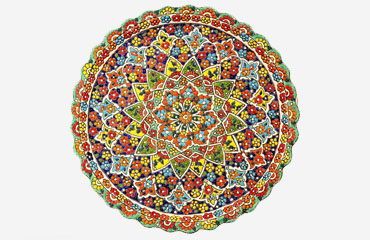


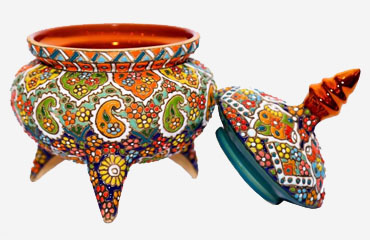


Enamel on Clay
Abstract

Porcelain enamel is a glassy material deposited on a metallic substrate and fired at high temperatures (500-900 °C) to form a stable and permanent bond with it through chemical-physical reaction. This coating was developed in ancient times for decorative purposes and it was mainly used to embellish precious objects with colourful and glossy finishing as if to imitate the shining of precious stones. Only from 1760 enamelling of metal objects began to play a technical role. Nowadays vitreous enamel coatings are widely used and appreciated for high-duty technological applications, as they provide good corrosion protection of the covered substrates and they can withstand chemical attack, abrasion, and degradation caused by external agents, maintaining their aesthetical properties unchanged in time. This work is to introduce and describe the history of enamelling from ancient times to the modern era, revealing the glorious past of this material for decorative purposes and its use as a technical coating from the First Industrial Revolution onward.
Enamelling on Clay
The history of enameling technique
Enameling goes back a long way in the age of time. The ancient historian, Josephus credits the first recorded artifacts in this process to the Old Testament Israelites, many of whom also popularized its use in jewelry made for the Early Kingdom pharaohs. An art from which reaches back five thousand years deserves to be understood, particularly when so many contemporary craftsmen are accepting its challenges.
The word enamel is from the french emaillr, designating an opaque glass whose hue can be altered by chemical action and heat. Enamel then, being a vitreous compound, cannot be older then the Israelites. (Other authorities credit its discovery to the Phoenician merchants who accidentally founds lumpe of crude glass in desert Campfires.) In any event, we have indisputable evidence in the form of artifacts which prove enameling was practiced many centuries before the Christian era.
The form of enameling which we know today is probably of Middle-Eastern and Asian origin. Enameled jewelry from Syria can be seen at the Louvre and British Museum. In 15th Century A.D. the Chinese had a flourishing industry which imitated "antique enamels" Add up all these dates and claims to origin and you have some confusion, but at any rate it indicates how popular and how long has been the tenure of the enamelist's craft.
There are six methods of enameling. Most of them bear French name: cloisonnec; champleve; basse-taille; plique-a-jour; painter's enamel and industrial enamel.